A coffee tasting event at the end of the spring semester is a second-year seminar tradition that predates the seminar requirement. Every spring since 2007, students in The Secret Life of Coffee have served up coffee and knowledge from around the world, in something like a science fair of coffee.
In 2020 and 2021, these are virtual events -- presentations to be enjoyed online. We offer a pre-tasting buying guidefor visitors who wish to prepare something appropriate to sip while enjoying the presentations.
Thanks to everyone who attended my presentation "Qahua to Coffee: Ancient & Modern Geographies of MENA's Signature Drink." I was pleased to be invited to speak as part of MENA Awareness Week at BSU, sponsored by the Middle East and North Africa program and the U.S. Department of Education.
Meanwhile: spotted on the Internet, so it might be true.
I am especially grateful for the questions and comments from colleagues that were offered at the end of the presentation. If you missed the program, I hope you will take the time to watch and to stay for the contributions of these colleagues -- it was very much a cross-cultural and interdisciplinary exchange.
In addition to the video, you are invited to view the slides -- anything on a slide that looks like a link is a link that leads to further information.
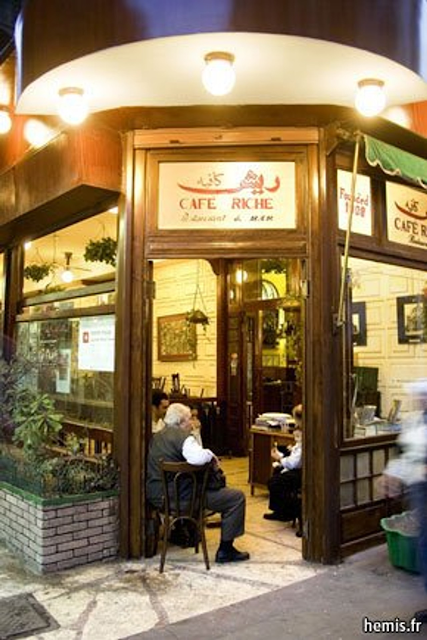
Among other things, "Qahua to Coffee" touches on the significance of the café shown below, which is situated in a neighborhood known as "Paris on the Nile." Café Riche has been serving coffee and conversation in Cairo since 1908.
Lagniappe
The MENA program that sponsored this event has also provided a small research grant for me to learn more about coffee in the region. Stay tuned: the Coffee Maven will have more to say on this subject!
After I gave this presentation, I turned to our copy of Yashim Cooks Istanbul in order to prepare a MENA-themed dinner. The resulting Hazelnut and Lemon Pilaf (findikli ve limonlu pilav) scored very high on our nutritious-delicious-easy-cheap trade-off matrix.
On March 8, author A.J. Jacobs visited (virtually) my Secret Life of Coffee class. This affable writer is the author of a handful of very interesting books, in which he sets himself rather ambitious personal challenges and then writes about the experience.
His visit was sponsored by Bridgewater One Book One Community, which has been organizing community-wide reading and associated activities since 2006.
Jacobs was introduced to me and the entire community by my favorite librarian, who has reviewed a couple of his books on her "Library" Books blog, which features hundreds of books (and a few films) whose common element is some mention of a library. In 2012 she reviewed Jacobs' Drop Dead Healthy, but she first learned of his work as part of her "Year of" Books project, in which she wrote about his works throughout her year of reading a particular kind of book. I do not write about books nearly as much as Pamela does, but I describe my appreciation for this book in a Goodreads review.
We already had the March 8 visit scheduled when I happened to hear Jacobs on the TED Radio Hour, in which he explores many additional aspects of what he calls the gratitude chain. This is an hour well spent, in which he mentions another of my favorite TED Talkers, Chimamanda Adichie. Jacobs also mentions author Mark Pendergrast, who long ago visited my Secret Life of Coffee and Geography of Coffee classes.
Lagniappe
Unlike. A.J. Jacobs and Chimamanda Adichie, my TED Talk has not made me famous. I did, however, speak about campus coffee at a local TEDx event. I invite readers to listen to my Coffee Belwetherstalk [sic: my misspelling is part of the talk] and to advocate for ethical coffee at BSU if it inspires them.
Taking on a few new roles during the 2020 pandemic, I allowed my email signature file to grow a bit beyond what is reasonable, as a beloved relative gently pointed out.
So I have outsourced the signature file, with a pointer to this post -- only for those who care enough to click to it. And now it might really grow, like a plant that has been moved to a bigger pot.
Each link above points to some aspect of my work or identity. In the case of my pronouns (he/el/ele), the link is to a general explanation of why people have started declaring their pronouns in this way. A more common format for CIS men would be (he/him/his), but I am starting to use "he" along with its Spanish and Portuguese equivalents, to signify that I'm open to conversation in these languages (with decent though not perfect fluency).
Our friends in Nicaragua face a multitude of challenges -- a terrible political situation, a global pandemic being handled poorly by the national government, and an economic depression resulting from both.
But Nicaraguans are incredibly resilient (a quality nobody should have to demonstrate as often as they do), and my friends in the coffeelands especially so. Some of them have responded in a way that is meeting economic, educational, ecological, and psychological needs all at once.
They are building on their expertise in sustainable tourism and environmental education to create an 18-month training program for local young people. This program will rely on monthly sponsorships.
On Wednesday evening August 19, we will be explaining the project in an online discussion. I will also be posting more details here, but if you can join us at 7:30 (U.S. East Coast time), please do.
Updated August 15, 2020: We had a very nice conversation on June 26 (see the promotional information below), and my friends at Equal captured it for others to see. Urgent family matters took my attention away for the following month, so I am only today remembering to post the video here. Please have a look.
Equal Exchange Action Forum is the consumer-organizing arm of the West Bridgewater-based company that is best known for its leadership in fair-trade coffee. Danielle Robidoux is one of the coordinators of the Action Forum, and a former student of mine. This message is from Danielle to the Action Forum network (and anybody interested in this work). The event is free, but pre-registration is required.
During this uncertain time and as in-person gatherings are still at a standstill we are going to continue to create virtual spaces for us to gather and learn together. Please join us for this upcoming virtual event!
What does coffee quality mean to Equal Exchange? What is the importance of coffee quality to our producer partners? How has quality evolved over the years? Join Mike Mowry, Coffee Quality Coordinator at Equal Exchange, and James Hayes-Bohanan, citizen-consumer member, teacher, and coffee geographer for a discussion on coffee quality.
Bridgewater State students at the world's first farmer-owned cupping lab.
The event is an online version of a public lecture that was originally scheduled as part of the community-wide read of Thanks a Thousand by A.J. Jacobs.
I will describe my own journey, beginning in our Bridgewater kitchen and ending in coffee farms in Nicaragua, Guatemala, Costa Rica, and beyond. Skipping over a few steps in the commodity chain, this presentation will begin with our daily coffee ritual and will then focus on the farmers to whom those rituals are connected.
You do not need to have read this book to attend this presentation, but it is a quick read (even by my slow-reader standards) and readily available online for those who wish to peruse it. View my slides to revisit any part of the presentation and to follow links for further exploration. A video of this presentation will be available after the event. May 6 Tasting Event: Please visit the GEOG298 blog for student presentations; please visit early to choose one or more coffees to order so that you can enhance the experience with remote tasting. Summer note: If you wish to learn more about coffee from the comfort of your home, please consider Coffee Week. We will be offering this 3-credit summer class June 15-19; it is open to BSU and non-BSU students alike, for undergraduate or graduate credit.